The $1 Trillion Invisible Workforce: Why Supporting Family Caregivers is the Next Leadership Frontier
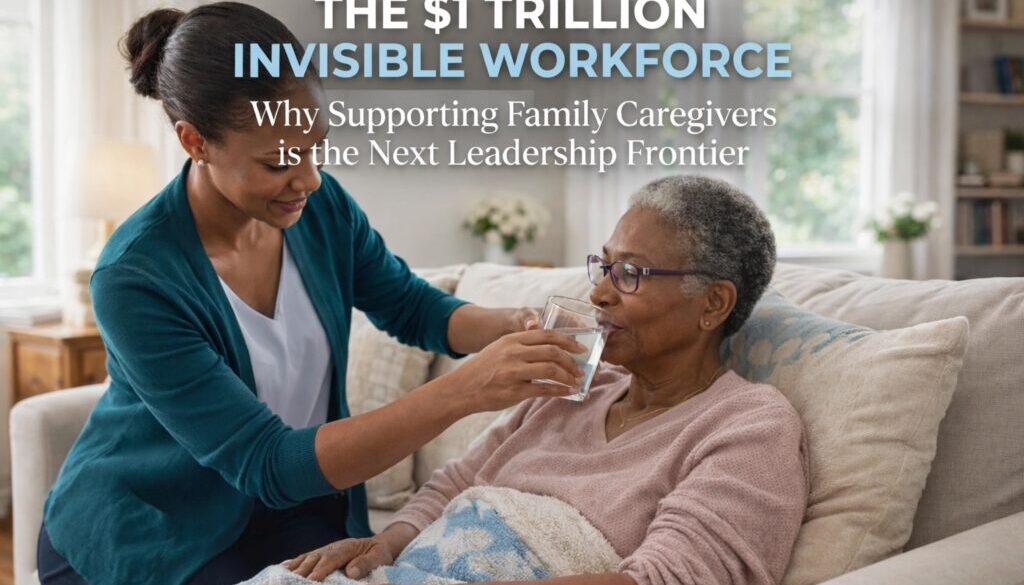
The backbone of our economy isn’t just found in glass-walled boardrooms or high-tech innovation hubs; it’s found in living rooms, quiet kitchens at 2:00 AM, and hospital corridors. We are currently witnessing the rise of a massive, essential, yet largely invisible workforce that is propping up our society.
According to the latest 2026 AARP update, family caregivers in the United States provided a staggering $1.01 trillion in economic value in 2024.
Read that number again. $1.01 trillion.
This isn’t just a family issue or a personal matter. This is a macroeconomic powerhouse fueled by 59 million individuals who are providing 49.5 billion hours of care annually. To put that in perspective, this contribution now exceeds the total federal, state, and local Medicaid spending of $932 billion. If we were to pay these family members for their labor at the average rate of $20.41 per hour, it would bankrupt the system.
As leaders, visionaries, and advocates for a thriving workplace, we can no longer afford to keep this workforce in the shadows. We must recognize that many of our highest-performing employees are working a double shift, delivering excellence in the office and essential, high-intensity care at home.
The Reality of the Double Shift
When we talk about burnout in the modern era, we often focus on hustle culture or the always-on nature of our devices. But for a significant portion of your talent pool, the burnout is deeper. It is the Quiet Burn that comes from balancing a career with the complex needs of an aging parent or a loved one with a chronic illness.
The AARP data reveals that 57% of these 59 million caregivers are providing high-intensity care. We aren’t just talking about picking up groceries; we are talking about complex medical and nursing tasks, administering injections, managing wound care, and navigating the labyrinth of the healthcare system.
These are your directors, your managers, and your rising stars. They are demonstrating incredible leadership lessons in resilience, empathy, and crisis management every single day before they even log on for their first meeting. However, when an organization fails to recognize this reality, they risk losing their most valuable assets to exhaustion and a perceived lack of support.
Why This is a Leadership Imperative
In my work as an executive coach and keynote speaker, I often tell audiences: You can’t yoga your way out of burnout, with a not to Paula Davis who coined the phrase. This is especially true for the caregiver. True support requires systemic change and a leadership shift from accommodating to advocating.
If you want to hone your leadership curation skills, you must curate a culture where caregiving is not a secret that employees feel they have to hide. When leaders acknowledge the $1 trillion contribution of this invisible workforce, they foster a culture of psychological safety.
Organizations that lead the way in this frontier will be those that offer:
- Flexible Work Integration: Moving beyond standard hours to results-based productivity.
- Caregiving Benefits: Access to resources, navigators, and emergency backup care.
- Empathetic Management: Training leaders to recognize the signs of caregiver strain before it leads to a resignation.
As we look toward the future, the lifelong learning imperative must include learning how to support a multigenerational workforce that is increasingly sandwiched between childcare and eldercare.
Ways to Nurture Yourself While Caring for Others
If you are one of the 59 million people providing that $1.01 trillion in value, please hear this: Your work is seen, and your contribution is immeasurable. But you cannot pour from an empty cup. To remain resilient, you must find small, sustainable ways to nurture yourself.
- Redefine Your Success: Sometimes, success isn’t about the promotion; it’s about maintaining your well-being through a difficult season. Define your success with strategic storytelling by telling yourself a kinder story about what you are achieving.
- Seek Micro-Rest: If you can’t take a week off, take ten minutes. Step outside, breathe, and disconnect. These tiny pulses of recovery are essential for longevity.
- Audit Your Capacity: Be honest about what you can realistically achieve. Finding meaningful work means finding work that fits within the framework of your whole life, not just your professional life.
- Ask for Help: This is the hardest leadership lesson to learn. Delegating isn’t a sign of weakness; it’s a strategy for sustainability.
The Economic Impact of Empathy
Some might argue that focusing on caregiving is soft leadership. The data says otherwise. When we fail to support caregivers, the economic fallout is felt in lost productivity, high turnover, and increased healthcare costs for the caregivers themselves.
By recognizing the value of the caregiving workforce at $20.41 per hour: we start to see it for what it is, a massive subsidy to our national economy. When organizations provide support, they aren’t just doing the right thing; they are protecting their bottom line.
As I share in my keynotes, investing in your people is the right thing to do. That investment must extend to the parts of their lives that happen outside the 9-to-5. We need to bridge the gap between our professional demands and our human needs.
A Vision for the Future
Imagine a workforce where the skills honed through caregiving: patience, strategic planning, high-stakes decision-making, and deep empathy are celebrated as core leadership competencies. Imagine an environment where taking a break for a caregiving emergency is met with the same professional respect as taking a break for a client meeting.
We are at a tipping point. The AARP 2026 update is a wake-up call for every CEO, HR professional, and manager. The Invisible Workforce is no longer willing to be invisible. They are the heroes among us, and it is time our leadership structures reflected that reality.
Whether you are a leader looking to better support your team, or a caregiver trying to navigate your own double shift, remember that you don’t have to do it alone. We can redefine the successful rainmaker to include those who lead with both their heads and their hearts.
Let’s stop asking caregivers to lean in without giving them a floor to stand on. It’s time to recognize the $1 trillion value and build a workplace that honors the human experience in its entirety.
Are you ready to transform your workplace culture and tackle burnout head-on? I work with organizations to build resilient, empathetic leadership teams. Let’s connect to discuss how a keynote or executive coaching can help your team thrive.
#Caregiving #Leadership #WorkplaceCulture #BurnoutPrevention #Resilience #FutureOfWork #AARP #EconomicImpact #InvisibleWorkforce #ExecutiveCoach #KeynoteSpeaker #CarolineDowdHiggins