The Cognitive Crunch: Is AI Accelerating Your Team’s Burnout?
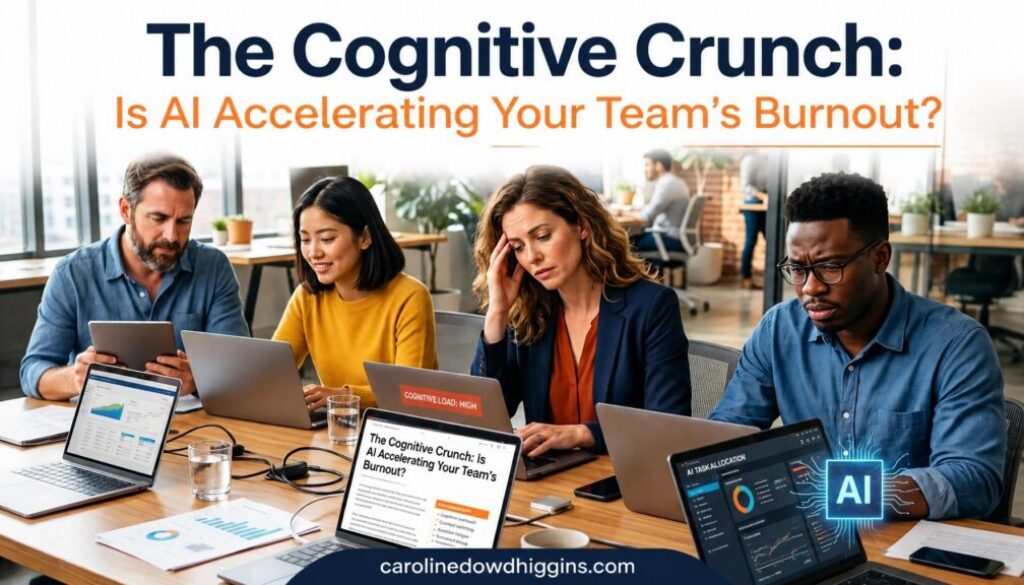
AI was supposed to be the great liberator. We were promised a world where machines handled the mundane, leaving humans to thrive in the creative and the strategic. But as we lean further into 2026, a different reality is emerging on the front lines of the corporate world.
While AI is undoubtedly speeding up our workflows, it is simultaneously depleting our most valuable resource: cognitive capacity.
In a groundbreaking exploration of this phenomenon, Dr. Natalie Cummins highlights a disturbing trend in her article, “The cognitive crunch: Why AI is accelerating burnout.” She argues that the question is no longer whether AI and burnout are connected, but what happens when these two juggernauts collide.
We aren’t just working faster; we are hitting a wall at record speed. This is the era of the Cognitive Crunch.
The Paradox of the Easy Button
For years, organizations have poured billions into artificial intelligence with the expectation of a massive productivity ROI. Yet, as Dr. Cummins points out, research from the Boston Consulting Group suggests that most organizations are seeing little to no measurable impact on profits.
Why the disconnect? Because while AI accelerates individual tasks, it often makes the overall nature of the work harder.
This is what experts call AI Brain Fry. A recent Harvard Business Review study found that employees interacting extensively with AI systems report significantly higher levels of information overload and mental fatigue. They aren’t just doing the work anymore; they are stuck in a relentless cycle of evaluation, correction, and verification.
Think about it, when an AI generates a report in three seconds, your job doesn’t disappear. It shifts. You are now the Cognitive Supervisor. You must verify the data, check for hallucinations, and ensure the tone aligns with your brand. The task took seconds, but the judgment required to validate it is exhausting.
Faster Work Does Not Mean Easier Work
The most dangerous myth in the modern workplace is that speed equals ease. In reality, the reduction in focus time, which has hit a three-year low, means that our brains are constantly switching gears.
When you use AI tools, you aren’t just completing tasks; you are engaging in always-on judgment. The boundaries between tasks have blurred. There is no longer a breather between finishing a draft and sending an email, because the AI generates both instantly. This constant state of high-stakes decision-making leads to a sustained cognitive demand that can leave a team depleted long before the clock strikes five.
If you feel like your team is on but effectively fried, you’re witnessing the Cognitive Crunch in real-time. This isn’t just standard fatigue; it’s a systematic overload of the human processor. To combat this, we must hone our leadership curation skills to better filter what requires our deep attention.
Accelerated Burnout: A New Leadership Crisis
Traditionally, burnout was a slow burn – a result of months or years of overwork. Today, we are seeing Accelerated Burnout. Because the decision timelines are compressed and the stream of information is continuous, employees are reaching the breaking point faster than ever before.
And here’s the kicker: your best people are the most at risk.
Recent global data from Gallup’s State of the Global Workplace reveals a startling trend. While leaders often report higher levels of engagement and wellbeing, they also report significantly higher levels of daily stress, anger, and sadness.
Engagement is not a shield against burnout. In fact, those most invested in the mission are often the ones carrying the heaviest cognitive load. They are the ones interpreting complex AI outputs and making the high-stakes calls that keep the ship upright. If we don’t address this, we risk losing our most experienced talent to a cycle of perpetual mental fatigue.
It’s time to ask, What would you do if you weren’t afraid? – to disrupt the status quo and put human capacity at the center of your strategy?
From Managing Workload to Managing Capacity
As leaders, the playbook has changed. You can no longer just manage what people are doing; you must manage how much their brains can handle. To thrive in an AI-enabled world, we must move toward a model of Cognitive Sustainability.
Here are the strategic imperatives for the new era of work:
- Protect Focus Time as a Strategic Asset: Deep work isn’t a luxury; it’s a necessity for high-level decision-making. Encourage no-interruptions blocks where AI tools are silenced.
- Monitor Cognitive Load, Not Just Output: We measure KPIs and ROI, but do we measure mental fatigue? It’s time to start asking teams about their brain fry levels alongside their productivity metrics.
- Redesign Roles for Supervision: If a role is 80% AI-generated output, the job description needs to reflect the high-level critical thinking required to supervise that output, rather than the doing of the task itself.
- Promote Cognitive Recovery: Just as athletes need rest after a peak performance competition or work out, knowledge athletes need time for reflection. Without it, performance risks plummeting.
The Future is Human-Centric
AI is an incredible tool, but it is not a replacement for human judgment, empathy, and visionary thinking. The real constraint in the AI era isn’t the technology – it’s the human spirit.
If we continue to treat our teams like machines that can simply process faster and faster, we will continue to see a rise in errors, a drop in retention, and a workforce that is disconnected from its purpose. We need to define our success with strategic storytelling and ensure that our humans remain the heroes of the narrative, not just the editors of an algorithm.
The Cognitive Crunch is a warning sign, but it’s also an opportunity. It’s an invitation to redesign work in a way that honors our humanity.
Are you ready to lead your team from burnout to brilliance?
Let’s start the conversation. Whether you need a keynote speaker to energize your next conference or executive coaching to help your leadership team navigate these complex shifts, I am here to help you build a workplace that is both high-performing and deeply sustainable.
Inspired by the insights of Dr. Natalie Cummins in “The cognitive crunch: Why AI is accelerating burnout.”
#WorkplaceWellbeing #AIBurnout #LeadershipDevelopment #CognitiveCapacity #FutureOfWork #ExecutiveCoaching #CarolineDowdHiggins #KeynoteSpeaker #ExecutiveCoach #CultureMatters #BanishBurnout #WellbeingAdvantage