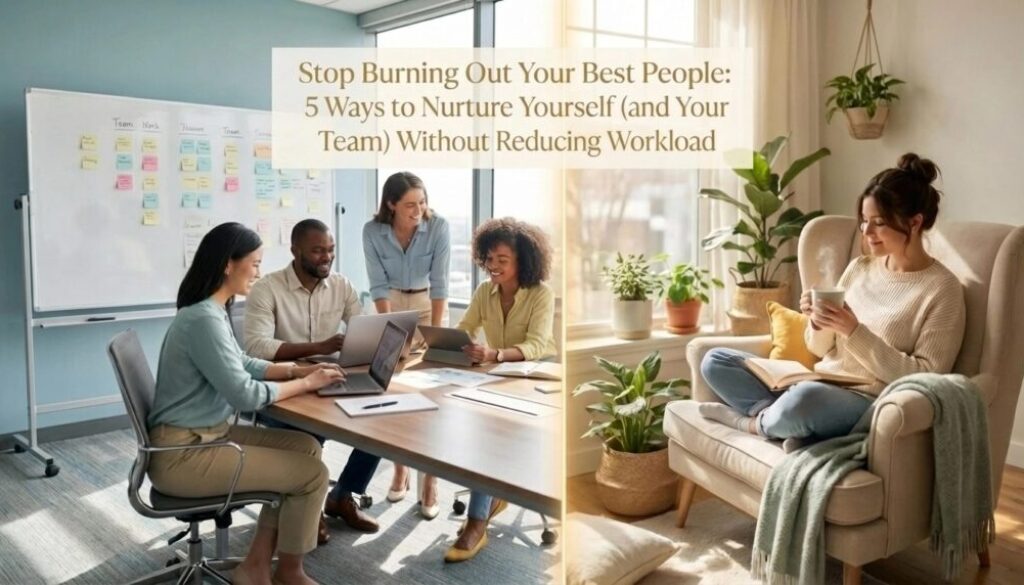
Stop Burning Out Your Best People: 5 Ways to Nurture Yourself (and Your Team) Without Reducing Workload
With burnout on the rise, it’s crucial to act now. Seventy-six percent of employees experience workplace burnout, and the cost of an employee leaving is usually equivalent to one year of their annual salary. You can’t afford to treat a severe injury with a Band-Aid. Throwing more time off at the problem doesn’t work (most over-workers don’t use all their PTO) —you need smarter systems that sustain human energy.
The good news? You can change how work gets done and how your people manage their energy while doing it.
Here are five practical, low-lift strategies you can implement immediately.
- Build Micro-Recovery Moments into Every Day
You’re not facing a time management deficit—you’re facing an energy management crisis.
Do this now:
- Follow the 90-minute rule. Schedule 10-minute breaks every 90 minutes to align with natural ultradian rhythms and prevent the afternoon crash.
- Make walking meetings your default. Take one-on-ones on foot. Same agenda, better oxygen and clarity.
- Use the 5-4-3-2-1 reset. In 90 seconds, ground your nervous system by naming 5 things you see, 4 you touch, 3 you hear, 2 you smell, 1 you taste.
The magic isn’t in working less—it’s in working with your biology. Want help building micro-recovery rhythms for your team? My Keynotes & Workshops make this easy to operationalize.
- Create Flexibility in How Work Happens (Not How Much)
When you can’t control the workload, control the context.
Try this:
- Set core collaboration hours. Agree upon a window of core availability hours and let people optimize the rest around energy and life demands.
- Offer location choice. If work can be done remotely, let people choose where they’re most productive. Commute stress alone contributes to 25% higher burnout rates.
- Enable task batching. Reduce context switching by grouping similar work—your team’s cognitive load drops immediately.
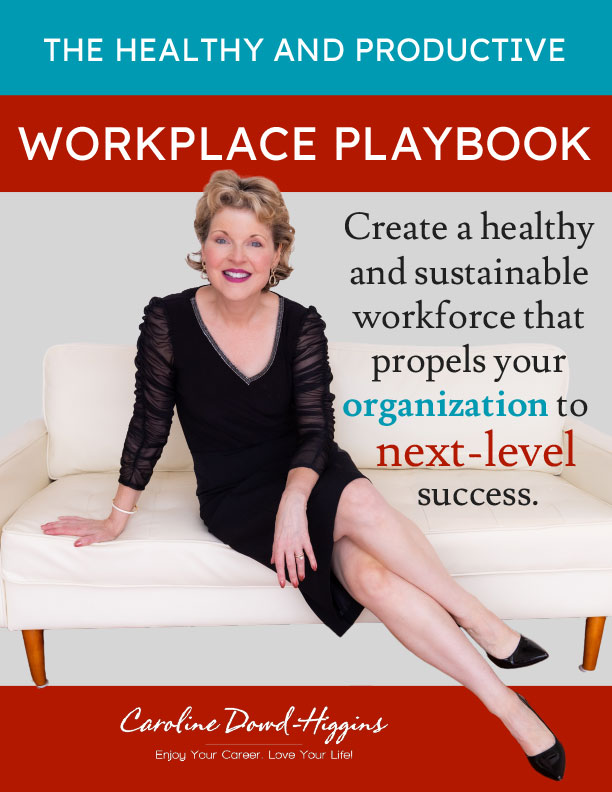
Flexibility isn’t about working less—it’s about working when and where you’re most effective. Need a proven framework? My Healthy and Productive Workplace Playbooks were created in collaboration with the Healthy Work Campaign and provide practical tactics to implement fast.
- Master Intentional Listening
Most burnout conversations happen too late. Don’t wait until people disengage, become unhealthy, or quit.
Adopt this cadence:
- One-on-ones with three questions: “What’s energizing you most? What’s draining you fastest? What would make next month more manageable?”
- Periodic pulse surveys that ask: Current stress level (1–10), biggest time waster, and one change that would improve how you work.
- Tight follow-through. Close the loop visibly. Nothing burns people out faster than feeling unheard when you ask and suggestions are ignored.
Want to level up your leader listening skills? Executive Coaching helps you turn insight into action with accountability.
- Establish Boundaries That Actually Stick
You may not control your entire schedule, but you can create constraints that protect focus and recovery.
For leaders:
- Communication windows. “I respond within 24 hours on business days; evenings and weekends are urgent-only.”
- Meeting-free mornings. Block 8–10am for deep work. Or a window that suits you best.
- The Sunday reset. Spend 20 minutes identifying your top three non-negotiables for the week.
For team members:
- The shutdown routine. End the day by writing tomorrow’s top three priorities to prevent late-night mental spirals.
- Email boundaries. Check at 9am, 1pm, and 4pm—not constantly.
- The 15-minute rule. If it takes less than 15 minutes, do it now; if not, schedule it.
Boundaries aren’t selfish—they’re performance infrastructure.
- Implement Recognition That Actually Matters
Generic “great job” feedback doesn’t move the needle. Specificity fuels energy and retention.
Make it meaningful:
- Tell the impact story. “Your late-night work on the Johnson project let us deliver early, strengthened the relationship, and positioned us for the next contract. I appreciate you.”
- Enable peer recognition. Create lightweight systems so teammates can spotlight contributions in real time.
- Track growth, not just goals. Acknowledge skill development and learning agility alongside outcomes.
Pro tip: Public recognition for achievements, private feedback for improvement. Always.
Your Next Steps
These strategies work when you apply them systematically. Start with the area that feels most urgent, then layer in the others over the next 30 days.
Want more resources? Grab my Healthy Workplace Playbooks, created in collaboration with the Healthy Work Campaign operationalize healthy, sustainable performance. Bringing this to your whole organization? Book a high-impact Keynote or Workshop. Ready to lead with more clarity and less overwhelm? Let’s talk Executive Coaching.
The best part? When you get this right, productivity and profitability and outcomes actually increases. The best outcome is that your people will be healthier and happier. We all deserve to do our best work and live our best lives at the same time.
What’s one strategy from this list you’ll try this week? Your future self (and your team) will thank you.
#BurnoutPrevention #WorkplaceWellbeing #EmployeeExperience #HumanCenteredLeadership #PeopleStrategy #PeakPerformanceCulture #ExecutiveCoach #KeynoteSpeaker